<?xml version="1.0" encoding="UTF-8"?>
<feed xmlns="http://www.w3.org/2005/Atom">
  <title type="text">New York City Guide 1939</title>
  <updated>2026-09-17T06:07:54+00:00</updated>
  <generator uri="http://framework.zend.com" version="1.12.20">Zend_Feed_Writer</generator>
  <link rel="alternate" type="text/html" href="https://ajlewis.org/"/>
  <link rel="self" type="application/atom+xml" href="https://ajlewis.org/items/browse?output=rss2"/>
  <id>https://ajlewis.org/</id>
  <author>
    <name>New York City Guide 1939</name>
    <uri>https://ajlewis.org</uri>
  </author>
  <link rel="hub" href="http://pubsubhubbub.appspot.com/"/>
  <entry>
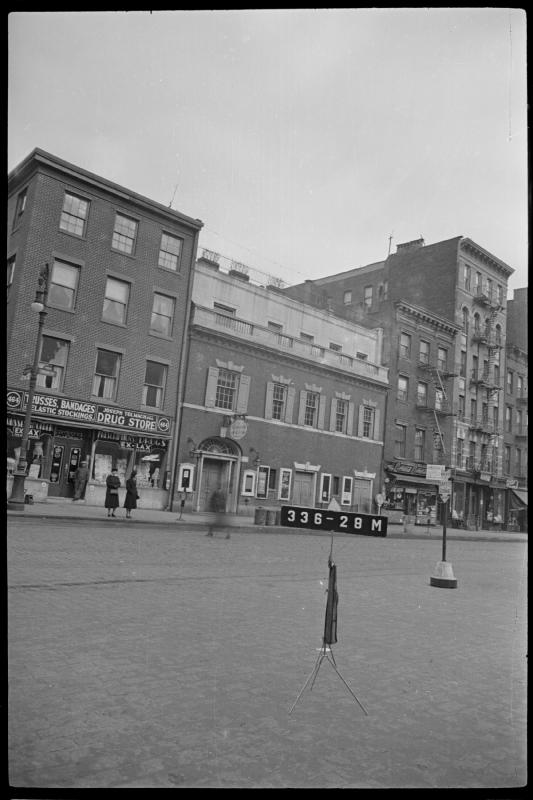
    <title type="html"><![CDATA[Henry Street Settlement Playhouse: Henry Street Settlement Playhouse]]></title>
    <summary type="html"><![CDATA[<p><strong><em>"Three blocks north, at 466 Grand Street, is the Henry Street Settlement's PLAYHOUSE, once famous as the Neighborhood Playhouse. Organized in 1915 for the purpose of staging productions of the settlement's dramatic groups, it branched out into professional production under the leadership of Alice and Irene Lewisohn. The Playhouse saw the American premieres of The Dybbuk and of James Joyce's Exiles. Yvette Guilbert; Roshanara, the Hindu dancer; Ratan Devi, the Hindu singer and musician; Rabindranath Tagore, the Indian poet; and the Isadora Duncan dancers appeared here. A satiric revue, the Grand Street Follies, was such a success that in 1927 it moved uptown. The theater now serves its original function" (Federal  Writers' Project (N.Y.), p. 116).</em></strong></p><img src="https://ajlewis.org/files/fullsize/b79af68f97fd59060ab3855acdceb874.jpg" alt="466-470 Grand Street" /><br/><p>Originally known as the Neighborhood Playhouse, one of America’s first “Little Theaters”, the performing arts building was later renamed the Harry De Jur Playhouse but is better known as the Henry Street Settlement Playhouse. It was developed in 1915 by Alice and Irene Lewisohn, who had a passion for the Arts and were involved with the Henry Street Settlement in 1911, to bring the arts and drama to the Lower East Side residents (Wikipedia, 2026; Henry Street Settlement). Their goal was to provide the neighborhood with access to high-quality arts such as theater, music, and dance. With the Playhouse being one of the earliest “Little Theaters”, it played a critical role in the launching of the alternative theater movement, presenting both commercial productions, experimental works, and innovative performances (Frick and LoMonaco, pp.1302-1303). Notable performances have occurred at the location, such as Aaron Copland’s “The Second Hurricane”, starring Eartha Kitt (Henry Street Settlement). The three-story Playhouse was designed by architects Harry C. Ingalls and F. Burrall Hoffman Jr. in the Georgian Revival style, with a carefully curated theater space that included fireproof curtains and heat-sensitive skylights, which were then groundbreaking features in fire safety. The theater could host both live performances and silent films, with a 350-seat capacity (Henry Street Settlement).</p><p><em><strong><a href="https://ajlewis.org/items/show/4">For more (including 5 images&#32;&amp;&#32;1 audio file) view the original article</a></strong></em></p>]]></summary>
    <published>2026-07-05T02:57:23+00:00</published>
    <updated>2026-07-26T17:59:32+00:00</updated>
    <link rel="alternate" type="text/html" href="https://ajlewis.org/items/show/4"/>
    <id>https://ajlewis.org/items/show/4</id>
    <author>
      <name>Abigail Lewis</name>
    </author>
  </entry>
</feed>
