Henry Street Settlement Playhouse

Henry Street Settlement Playhouse
"Three blocks north, at 466 Grand Street, is the Henry Street Settlement's PLAYHOUSE, once famous as the Neighborhood Playhouse. Organized in 1915 for the purpose of staging productions of the settlement's dramatic groups, it branched out into professional production under the leadership of Alice and Irene Lewisohn. The Playhouse saw the American premieres of The Dybbuk and of James Joyce's Exiles. Yvette Guilbert; Roshanara, the Hindu dancer; Ratan Devi, the Hindu singer and musician; Rabindranath Tagore, the Indian poet; and the Isadora Duncan dancers appeared here. A satiric revue, the Grand Street Follies, was such a success that in 1927 it moved uptown. The theater now serves its original function" (Federal Writers' Project (N.Y.), p. 116).

Originally known as the Neighborhood Playhouse, one of America’s first “Little Theaters”, the performing arts building was later renamed the Harry De Jur Playhouse but is better known as the Henry Street Settlement Playhouse. It was developed in 1915 by Alice and Irene Lewisohn, who had a passion for the Arts and were involved with the Henry Street Settlement in 1911, to bring the arts and drama to the Lower East Side residents (Wikipedia, 2026; Henry Street Settlement). Their goal was to provide the neighborhood with access to high-quality arts such as theater, music, and dance. With the Playhouse being one of the earliest “Little Theaters”, it played a critical role in the launching of the alternative theater movement, presenting both commercial productions, experimental works, and innovative performances (Frick and LoMonaco, pp.1302-1303). Notable performances have occurred at the location, such as Aaron Copland’s “The Second Hurricane”, starring Eartha Kitt (Henry Street Settlement). The three-story Playhouse was designed by architects Harry C. Ingalls and F. Burrall Hoffman Jr. in the Georgian Revival style, with a carefully curated theater space that included fireproof curtains and heat-sensitive skylights, which were then groundbreaking features in fire safety. The theater could host both live performances and silent films, with a 350-seat capacity (Henry Street Settlement).

Audio

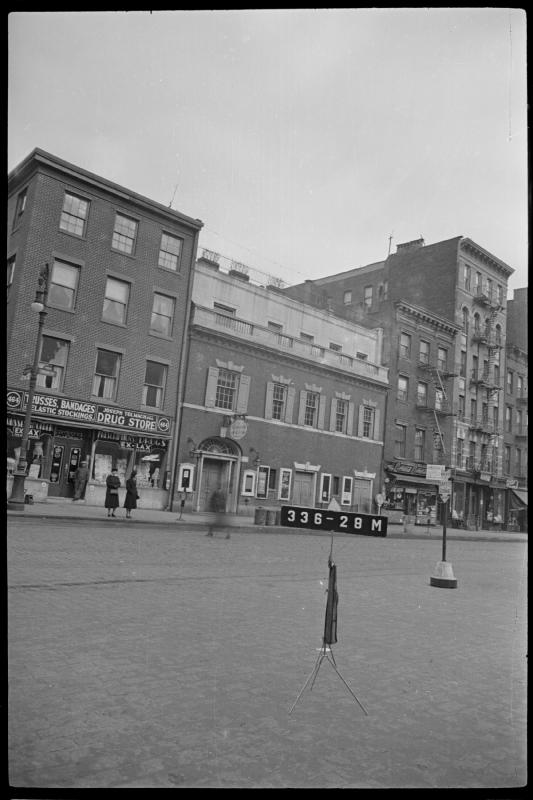
Analysis of 1940 Tax Department Photograph Henry Street Settlement Playhouse This black-and-white photograph from the New York City Tax Department shows the Henry Street Settlement Playhouse as it appeared in the 1940s, viewed from across Grand Street. The Playhouse is a three-story red brick building with a symmetrical facade and a low, flat roof topped by a projecting cornice. The main entrance sits left of center of the building beneath a rounded arch framed with light trim. 3 white, contrasting poster cases are mounted on the Playhouse's front, likely used to advertise upcoming performances and features. The upper stories consist of tall, rectangular shuttered windows, with stone lintels and molded trim highlighting their design for a theatrical, sophisticated appearance. To the left of the Playhouse is Joseph Tolmach's Drug Store, with an advertisement for bandages, elastic stockings, and trusses. To the right are taller brick buildings with fire escapes, indicating residential units above commercial storefronts and businesses. In the foreground, 2 pedestrians wait alongside the street. The image captures both the historic architecture of the Playhouse and the active neighborhood life of the Lower East Side that surrounds it. Source: Written & Recorded by Abigail Lewis Date: 26 July 2026

Images

466-470 Grand Street
466-470 Grand Street A black-and-white photograph of 466-477 Grand Street on the Lower East Side. The photo features multiple three and four-story masonry buildings. To the left is Joseph Tolmach Drug Store, shown advertising bandages, elastic stockings, and trusses. To the right of the drug store is the three-story brick Neighborhood Playhouse, featuring an arched entrance, decorative window shutters, and molded wall decals and boldly framed performance advertisements. Nestled to the right of the playhouse is a thin, four-story building with a Luncheonette on the first level and a fire escape extending to the upper floors of apartment housing. Two pedestrians stand on the sidewalk outside the drug store, waiting at the street side, as a citizen is seated out front of the playhouse entrance. The foreground street is mostly empty, with a blur of a walking pedestrian and a Police Safety Zone sign, along with a survey marker labeled 366-28 M to indicate the position of the photograph survey. Source: New York City Municipal Archives Creator: New York (N.Y.). Department of Finance Date: 1939-1941
Plate 16, Part of Sections 1 & 2: [Bounded by Broome Street, Willet Street, Grand Street, East Broadway, Pike Street, Division Street and Orchard Street]
Plate 16, Part of Sections 1 & 2: [Bounded by Broome Street, Willet Street, Grand Street, East Broadway, Pike Street, Division Street and Orchard Street] A detailed 1930 fire insurance map of the Lower East Side. Along Grand Street on Block 336, between Pitt Street and Willett Street, sits the Henry Street Settlement Playhouse (Neighborhood Theater) at 466 Grand Street, surrounded by mixed-use buildings for shops and residential purposes. Northeast of the theater, along Willett Street, sits a large synagogue, and opposite the block, along Pitt Street, is a settlement house. Source: New York Public Library Digital Collections Creator: G.W. Bromley & Co. Date: 1930
464-80 Grand Street
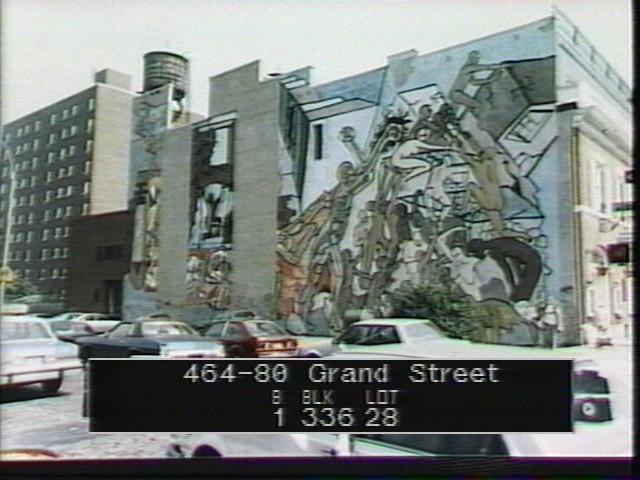
464-80 Grand Street This color photograph of 464-480 Grand Street on the Lower East Side shows a different perspective of the changes taking place around the historic Henry Street Settlement Playhouse. The neighboring drugstore building from the 1930s was demolished and replaced with parking spaces for vehicles. The adjacent walls of the buildings are covered with large murals, depicting modern urban art. A ten-story apartment building sits in the background, and a rooftop water tower is visible above the buildings. The front side of the playhouse remains preserved, with the familiar arched entrance and vintage sign just visible at the right edge of the photograph. Source: New York City Municipal Archives Creator: New York (N.Y.). Department of Finance Date: 1983-1988
Neighborhood Playhouse
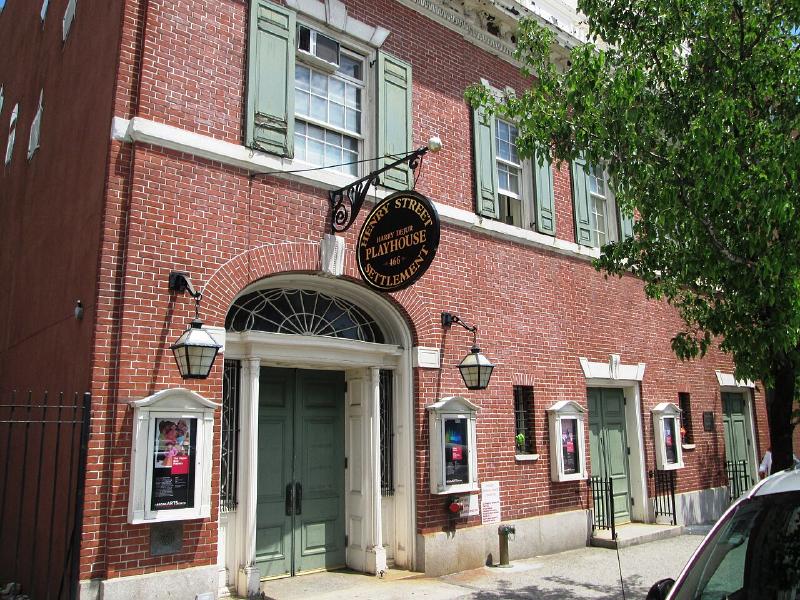
Neighborhood Playhouse This color photograph was taken in 2013, depicting the entrance to the Henry Dejuer Playhouse, or the Henry Street Settlement Playhouse, at 466 Grand Street on the Lower East Side. The historical building features its long-standing central entrance with an arched overhead window, white trim, and green double doors. On either side of the entrance, decorative vintage lanterns still dangle, and overhead, an iron bracket holds a sign reading "Henry Street Settlement- Harry Dejuer Playhouse." Advertising cases flank the entrance, and to the left-hand side of the building, classic brick siding has replaced the 1980s mural. Source: Wikimedia; Neighborhood Playhouse entrance Creator: Beyond My Ken Date: 12 May 2013
466 Grand Street, Henry Street Settlement Playhouse (Google Street View)
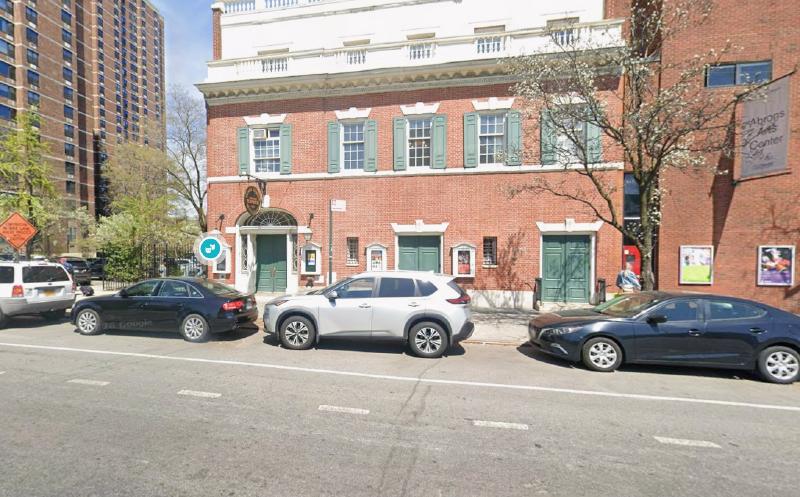
466 Grand Street, Henry Street Settlement Playhouse (Google Street View) This Google Street View image of 466 Grand Street shows Henry Street Settlement Playhouse in April of 2026. The historic red brick and the building's other timeless features have been maintained, along with its founding purpose as a performing arts building. Several cars are parked along the street, and elder trees grow in frame along the building's exterior. Source: 466 Grand St., N.Y., Google Street View Date: April 2026

Location

466 Grand Street, New York City, N.Y.

Metadata

Abigail Lewis, “Henry Street Settlement Playhouse: Henry Street Settlement Playhouse,” New York City Guide 1939, accessed September 17, 2026, https://ajlewis.org/items/show/4.