<?xml version="1.0" encoding="UTF-8"?>
<feed xmlns="http://www.w3.org/2005/Atom">
  <title type="text">New York City Guide 1939</title>
  <updated>2026-09-17T05:16:51+00:00</updated>
  <generator uri="http://framework.zend.com" version="1.12.20">Zend_Feed_Writer</generator>
  <link rel="alternate" type="text/html" href="https://ajlewis.org/"/>
  <link rel="self" type="application/atom+xml" href="https://ajlewis.org/items/browse?output=rss2"/>
  <id>https://ajlewis.org/</id>
  <author>
    <name>New York City Guide 1939</name>
    <uri>https://ajlewis.org</uri>
  </author>
  <link rel="hub" href="http://pubsubhubbub.appspot.com/"/>
  <entry>
    <title type="html"><![CDATA[Educational Alliance: 197 East Broadway Street]]></title>
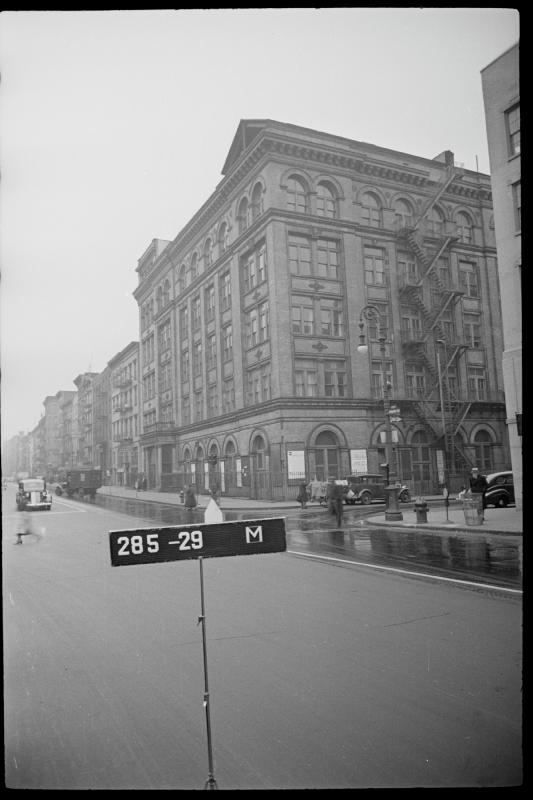
    <summary type="html"><![CDATA[<p><strong><em>"On the next corner, East Broadway at Jefferson Street, the EDUCATIONAL ALLIANCE, a non-sectarian social settlement maintained by Jewish societies, organizes educational and recreational activities for the neighborhood" (NYC Guide, p. 115).</em></strong></p><img src="https://ajlewis.org/files/fullsize/e929cb7d71cc3d6e61c3d0c10f491bb6.jpg" alt="193 East Broadway" /><br/><p>In 1889, the Educational Alliance was established as a five-story, sturdy brick settlement house at 197 East Broadway to support the immigration influx of Eastern European Jews to New York City's Lower East Side (Berrol, pp. 401-402; Wikipedia, 2026). The building is recognizable by its large rectangular windows, decorative stone detailing, and prominence in size along East Broadway. Funded by Jewish philanthropists with an initial investment of $125,000, the Educational Alliance was built and organized, educating immigrants and assisting with adaptation to American citizen life through educational and social programs (Sampson, 2012; Berrol, pp. 401-402). Beyond just educational programs, the Educational Alliance promoted health and wellness, providing activities, summer camps, hygiene education, and a safe space for immigrant communities to develop social connections (Sampson, 2012). As community needs changed, the Educational Alliance expanded from its original mission by including senior citizens' living centers, disability programs, and expanding to branches on Manhattan's West Side (Berrol, pp. 401-402). Today, the building remains the home for the Educational Alliance and, following 2013 renovations, became a host for the Manny Cantor Center, offering a preschool, Head Start program, arts, recreational services, along with elder and teen services. </p><p><em><strong><a href="https://ajlewis.org/items/show/5">For more (including 5 images&#32;&amp;&#32;1 audio file) view the original article</a></strong></em></p>]]></summary>
    <published>2026-07-14T18:33:13+00:00</published>
    <updated>2026-07-26T17:09:32+00:00</updated>
    <link rel="alternate" type="text/html" href="https://ajlewis.org/items/show/5"/>
    <id>https://ajlewis.org/items/show/5</id>
    <author>
      <name>Abigail Lewis</name>
    </author>
  </entry>
  <entry>
    <title type="html"><![CDATA[Henry Street Settlement (Main House): Henry Street Settlement (Main House)]]></title>
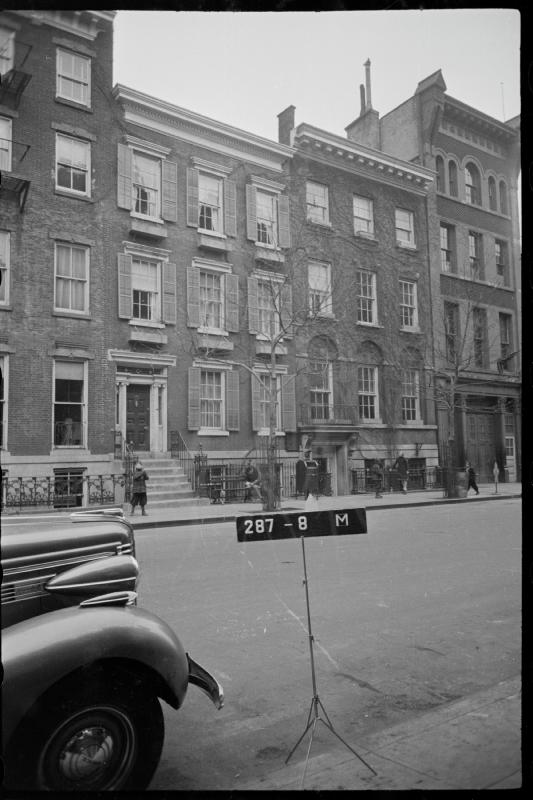
    <summary type="html"><![CDATA[<p><strong><em>"The famous Henry Street Settlement, at 265 Henry, a block south of East Broadway, still maintains its modest main house. Opened in 1893 by one of the great pioneers in social work, Lillian Wald, the settlement has attracted world-wide attention through its work in nursing the sick, aiding in the solution of domestic and social problems, and striving for better housing, recreation, and education facilities in the slums of the Lower East Side" (Federal Writers' Project N.Y.,p. 115).</em></strong></p><img src="https://ajlewis.org/files/fullsize/d6ac1b637388380b789b4574ce242560.jpg" alt="265-267 Henry Street" /><br/><p>Poor living conditions, limited availability of social services, and a lack of healthcare for immigrant residents of the Lower East Side were all too common a sight for nurses Lillian Wald and Mary Brewster (Henry Street Settlement). From their experiences, the pair of nurses drew inspiration to found the Nurses’ Settlement in 1892, later renamed the Henry Street Settlement, with the mission of providing non-profit social, educational, and health services to poor urban communities (Wikipedia contributors, 2026). By 1895, 265 Henry Street had been purchased by banker and philanthropist Jacob Schiff, who, after its renovation, gifted the town-home-style property to the young organization, which served as the Henry Street Settlement headquarters and became the first settlement in the United States to offer visiting nurse service (Buhler-Wilkerson, p. 591). By the beginning of the twentieth century, the settlement had expanded its capacity, operated a seven-day-a-week nursing service and convalescent homes, and maintained first-aid stations and community clubs (Buhler-Wilkerson, p. 591). The Henry Street Settlement established itself as one of the most adaptable settlement institutions in New York City (Boyd-Caroli, pp. 1171-1172); it expanded its programs and services as community needs changed over time, having housed 41 women by 1911, provided 24-hour labor and maternal care, and established educational health conferences for infancy and motherhood (Buhler-Wilkerson, p. 591).</p><p><em><strong><a href="https://ajlewis.org/items/show/3">For more (including 5 images&#32;&amp;&#32;1 audio file) view the original article</a></strong></em></p>]]></summary>
    <published>2026-06-29T19:33:48+00:00</published>
    <updated>2026-07-26T17:32:18+00:00</updated>
    <link rel="alternate" type="text/html" href="https://ajlewis.org/items/show/3"/>
    <id>https://ajlewis.org/items/show/3</id>
    <author>
      <name>Abigail Lewis</name>
    </author>
  </entry>
</feed>