<?xml version="1.0" encoding="UTF-8"?>
<feed xmlns="http://www.w3.org/2005/Atom">
  <title type="text">New York City Guide 1939</title>
  <updated>2026-09-17T05:14:05+00:00</updated>
  <generator uri="http://framework.zend.com" version="1.12.20">Zend_Feed_Writer</generator>
  <link rel="alternate" type="text/html" href="https://ajlewis.org/"/>
  <link rel="self" type="application/atom+xml" href="https://ajlewis.org/items/browse?output=rss2"/>
  <id>https://ajlewis.org/</id>
  <author>
    <name>New York City Guide 1939</name>
    <uri>https://ajlewis.org</uri>
  </author>
  <link rel="hub" href="http://pubsubhubbub.appspot.com/"/>
  <entry>
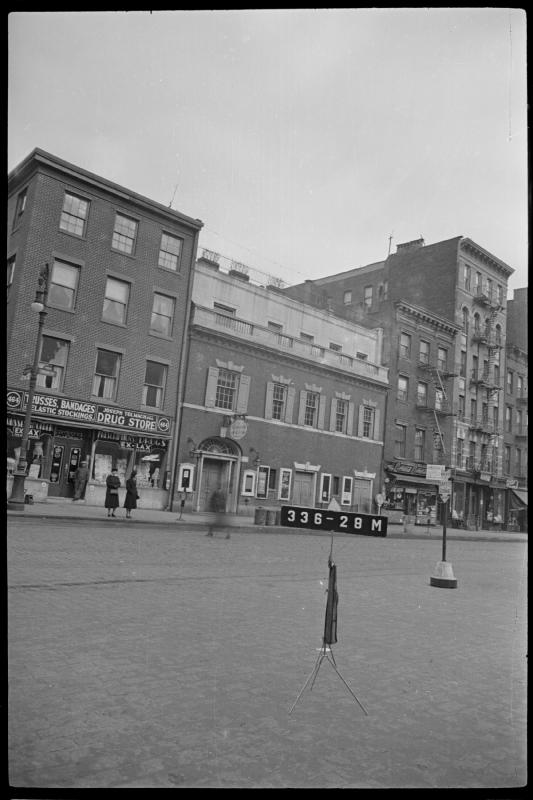
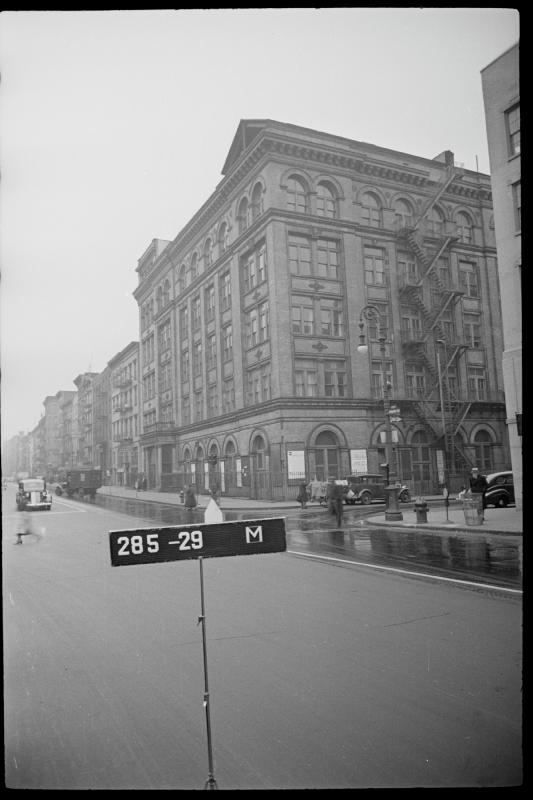
    <title type="html"><![CDATA[Educational Alliance: 197 East Broadway Street]]></title>
    <summary type="html"><![CDATA[<p><strong><em>"On the next corner, East Broadway at Jefferson Street, the EDUCATIONAL ALLIANCE, a non-sectarian social settlement maintained by Jewish societies, organizes educational and recreational activities for the neighborhood" (NYC Guide, p. 115).</em></strong></p><img src="https://ajlewis.org/files/fullsize/e929cb7d71cc3d6e61c3d0c10f491bb6.jpg" alt="193 East Broadway" /><br/><p>In 1889, the Educational Alliance was established as a five-story, sturdy brick settlement house at 197 East Broadway to support the immigration influx of Eastern European Jews to New York City's Lower East Side (Berrol, pp. 401-402; Wikipedia, 2026). The building is recognizable by its large rectangular windows, decorative stone detailing, and prominence in size along East Broadway. Funded by Jewish philanthropists with an initial investment of $125,000, the Educational Alliance was built and organized, educating immigrants and assisting with adaptation to American citizen life through educational and social programs (Sampson, 2012; Berrol, pp. 401-402). Beyond just educational programs, the Educational Alliance promoted health and wellness, providing activities, summer camps, hygiene education, and a safe space for immigrant communities to develop social connections (Sampson, 2012). As community needs changed, the Educational Alliance expanded from its original mission by including senior citizens' living centers, disability programs, and expanding to branches on Manhattan's West Side (Berrol, pp. 401-402). Today, the building remains the home for the Educational Alliance and, following 2013 renovations, became a host for the Manny Cantor Center, offering a preschool, Head Start program, arts, recreational services, along with elder and teen services. </p><p><em><strong><a href="https://ajlewis.org/items/show/5">For more (including 5 images&#32;&amp;&#32;1 audio file) view the original article</a></strong></em></p>]]></summary>
    <published>2026-07-14T18:33:13+00:00</published>
    <updated>2026-07-26T17:09:32+00:00</updated>
    <link rel="alternate" type="text/html" href="https://ajlewis.org/items/show/5"/>
    <id>https://ajlewis.org/items/show/5</id>
    <author>
      <name>Abigail Lewis</name>
    </author>
  </entry>
  <entry>
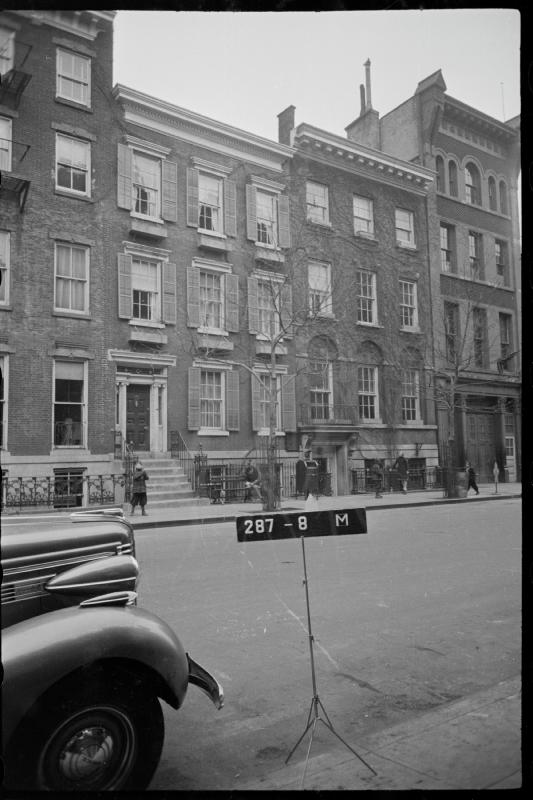
    <title type="html"><![CDATA[Henry Street Settlement Playhouse: Henry Street Settlement Playhouse]]></title>
    <summary type="html"><![CDATA[<p><strong><em>"Three blocks north, at 466 Grand Street, is the Henry Street Settlement's PLAYHOUSE, once famous as the Neighborhood Playhouse. Organized in 1915 for the purpose of staging productions of the settlement's dramatic groups, it branched out into professional production under the leadership of Alice and Irene Lewisohn. The Playhouse saw the American premieres of The Dybbuk and of James Joyce's Exiles. Yvette Guilbert; Roshanara, the Hindu dancer; Ratan Devi, the Hindu singer and musician; Rabindranath Tagore, the Indian poet; and the Isadora Duncan dancers appeared here. A satiric revue, the Grand Street Follies, was such a success that in 1927 it moved uptown. The theater now serves its original function" (Federal  Writers' Project (N.Y.), p. 116).</em></strong></p><img src="https://ajlewis.org/files/fullsize/b79af68f97fd59060ab3855acdceb874.jpg" alt="466-470 Grand Street" /><br/><p>Originally known as the Neighborhood Playhouse, one of America’s first “Little Theaters”, the performing arts building was later renamed the Harry De Jur Playhouse but is better known as the Henry Street Settlement Playhouse. It was developed in 1915 by Alice and Irene Lewisohn, who had a passion for the Arts and were involved with the Henry Street Settlement in 1911, to bring the arts and drama to the Lower East Side residents (Wikipedia, 2026; Henry Street Settlement). Their goal was to provide the neighborhood with access to high-quality arts such as theater, music, and dance. With the Playhouse being one of the earliest “Little Theaters”, it played a critical role in the launching of the alternative theater movement, presenting both commercial productions, experimental works, and innovative performances (Frick and LoMonaco, pp.1302-1303). Notable performances have occurred at the location, such as Aaron Copland’s “The Second Hurricane”, starring Eartha Kitt (Henry Street Settlement). The three-story Playhouse was designed by architects Harry C. Ingalls and F. Burrall Hoffman Jr. in the Georgian Revival style, with a carefully curated theater space that included fireproof curtains and heat-sensitive skylights, which were then groundbreaking features in fire safety. The theater could host both live performances and silent films, with a 350-seat capacity (Henry Street Settlement).</p><p><em><strong><a href="https://ajlewis.org/items/show/4">For more (including 5 images&#32;&amp;&#32;1 audio file) view the original article</a></strong></em></p>]]></summary>
    <published>2026-07-05T02:57:23+00:00</published>
    <updated>2026-07-26T17:59:32+00:00</updated>
    <link rel="alternate" type="text/html" href="https://ajlewis.org/items/show/4"/>
    <id>https://ajlewis.org/items/show/4</id>
    <author>
      <name>Abigail Lewis</name>
    </author>
  </entry>
  <entry>
    <title type="html"><![CDATA[Henry Street Settlement (Main House): Henry Street Settlement (Main House)]]></title>
    <summary type="html"><![CDATA[<p><strong><em>"The famous Henry Street Settlement, at 265 Henry, a block south of East Broadway, still maintains its modest main house. Opened in 1893 by one of the great pioneers in social work, Lillian Wald, the settlement has attracted world-wide attention through its work in nursing the sick, aiding in the solution of domestic and social problems, and striving for better housing, recreation, and education facilities in the slums of the Lower East Side" (Federal Writers' Project N.Y.,p. 115).</em></strong></p><img src="https://ajlewis.org/files/fullsize/d6ac1b637388380b789b4574ce242560.jpg" alt="265-267 Henry Street" /><br/><p>Poor living conditions, limited availability of social services, and a lack of healthcare for immigrant residents of the Lower East Side were all too common a sight for nurses Lillian Wald and Mary Brewster (Henry Street Settlement). From their experiences, the pair of nurses drew inspiration to found the Nurses’ Settlement in 1892, later renamed the Henry Street Settlement, with the mission of providing non-profit social, educational, and health services to poor urban communities (Wikipedia contributors, 2026). By 1895, 265 Henry Street had been purchased by banker and philanthropist Jacob Schiff, who, after its renovation, gifted the town-home-style property to the young organization, which served as the Henry Street Settlement headquarters and became the first settlement in the United States to offer visiting nurse service (Buhler-Wilkerson, p. 591). By the beginning of the twentieth century, the settlement had expanded its capacity, operated a seven-day-a-week nursing service and convalescent homes, and maintained first-aid stations and community clubs (Buhler-Wilkerson, p. 591). The Henry Street Settlement established itself as one of the most adaptable settlement institutions in New York City (Boyd-Caroli, pp. 1171-1172); it expanded its programs and services as community needs changed over time, having housed 41 women by 1911, provided 24-hour labor and maternal care, and established educational health conferences for infancy and motherhood (Buhler-Wilkerson, p. 591).</p><p><em><strong><a href="https://ajlewis.org/items/show/3">For more (including 5 images&#32;&amp;&#32;1 audio file) view the original article</a></strong></em></p>]]></summary>
    <published>2026-06-29T19:33:48+00:00</published>
    <updated>2026-07-26T17:32:18+00:00</updated>
    <link rel="alternate" type="text/html" href="https://ajlewis.org/items/show/3"/>
    <id>https://ajlewis.org/items/show/3</id>
    <author>
      <name>Abigail Lewis</name>
    </author>
  </entry>
  <entry>
    <title type="html"><![CDATA[196 Elizabeth Street: Who lived at 196 Elizabeth Street in the 1930s?]]></title>
    <summary type="html"><![CDATA[<img src="https://ajlewis.org/files/fullsize/e97ef1f8d4444d9b309823b44fc9f0bc.jpg" alt="196 Elizabeth Street" /><br/><p>The census records for the years 1930 and 1940 for 196 Elizabeth Street residents demonstrated that many of them were Italian-born immigrants, which is a glimpse into how prominent of a contribution of Italian settlements had in the population trends of New York City. According to the 1940 Census, the population of New York City totaled 7,454,995 residents, with 2,080,020 of them recorded as foreign-born white (U.S. Census Bureau, 1943, p.156-157). Italian-born immigrants were among the largest groups in this category, with numbers reaching 440,250 in 1930 and declining to 409,489 by 1940, but representing 19.7% of the city’s foreign-born white population that year (U.S. Census Bureau, 1943, p. 159). Italian immigrants settled in an area of Lower Manhattan in the 1850s, dubbed “Little Italy,” and by the 1920s, it had become a prominent Italian community in New York City (Hodges, 2010, p. 758). Ethnic communities like Little Italy allowed Italian immigrants to find housing, work, and even led to the establishment of businesses, Roman Catholic places of worship, and heritage-based social communities (Hodges, 2010, p. 758). So, considering this, it is not surprising that the majority demographic for the residents of 196 Elizabeth Street were Italian immigrants or the children of Italian immigrants. By 1940, all 59 residents of the building were recorded as white, 25 were born in Italy, and 32 were New York-born, most with Italian-born parents. This shows a mix of first- and second-generation Italian immigrants, who were among the largest groups of foreign-born immigrants. Rather than this being an isolated trend, the building is only just one example of the broader population patterns in New York City.</p><p><em><strong><a href="https://ajlewis.org/items/show/2">For more (including 3 images) view the original article</a></strong></em></p>]]></summary>
    <published>2026-06-26T00:39:02+00:00</published>
    <updated>2026-06-26T20:29:03+00:00</updated>
    <link rel="alternate" type="text/html" href="https://ajlewis.org/items/show/2"/>
    <id>https://ajlewis.org/items/show/2</id>
    <author>
      <name>Abigail Lewis</name>
    </author>
  </entry>
</feed>